Episode 2 starts with a hard truth.
Our KEMROC cutters were not at Black Rock Mine where they were scheduled to be demonstrated. They were sitting miles away in the Arizona Strip, one of the most remote regions in the United States. Before any gypsum cutting could begin, the Arizona Strip equipment recovery had to happen.
This is not a typical job site environment. There is no physical address for the quarry. Access depends on gravel roads and unmarked desert paths. When you are working off location pins instead of street signs, small mapping errors can create major problems.
Meeting Matt’s Off Road Recovery in the High Desert
To retrieve the stranded attachments, we met up with Matt’s Off Road Recovery, a team that knows this terrain well. Their local knowledge proved critical. Relying on GPS alone would not have been enough to complete this Arizona Strip equipment recovery safely.
The route took us through rough desert trails and across multiple cattle gates that had to be opened and closed along the way. At one point, we were still a mile and a half away from the GPS destination when the recovery team turned off the main road. The digital pin showed one thing, but the actual turnoff was somewhere else entirely.
When GPS Pins Do Not Match Reality
Out in the Arizona Strip, there are multiple parallel paths that all look like they lead to the same place. They are not county roads in the way most contractors think of county roads. They are livestock routes and desert tracks that split and rejoin without warning.
During this Arizona Strip equipment recovery, we experienced firsthand how unreliable digital navigation can be in remote mining areas. The coordinates provided for the load did not line up with the actual access point. If a driver is working only from a pin with no physical address and no landmarks, it is easy to understand how the load could end up miles off course. If you wish to watch the episode, click below!
Locating and Extracting the KEMROC Cutters
After several miles of desert travel, the cutters finally came into view. The trailer was positioned in uneven terrain surrounded by rock and cactus hazards. Before moving anything, the recovery team assessed the path, cleared loose rock, and confirmed there was enough room to maneuver safely.
Despite how it looked, the truck did not require a heavy pull. With experienced spotters guiding every movement, the driver was able to back the trailer out carefully and return to a more stable path. Having multiple sets of eyes watching tire placement and clearance made the difference between a controlled exit and a damaged trailer.
Returning to Black Rock Mine
Once the cutters were back on a usable route, the final step in the Arizona Strip equipment recovery was escorting the truck safely toward Black Rock Mine. The terrain was still rough, but it was manageable compared to where the load had been sitting.
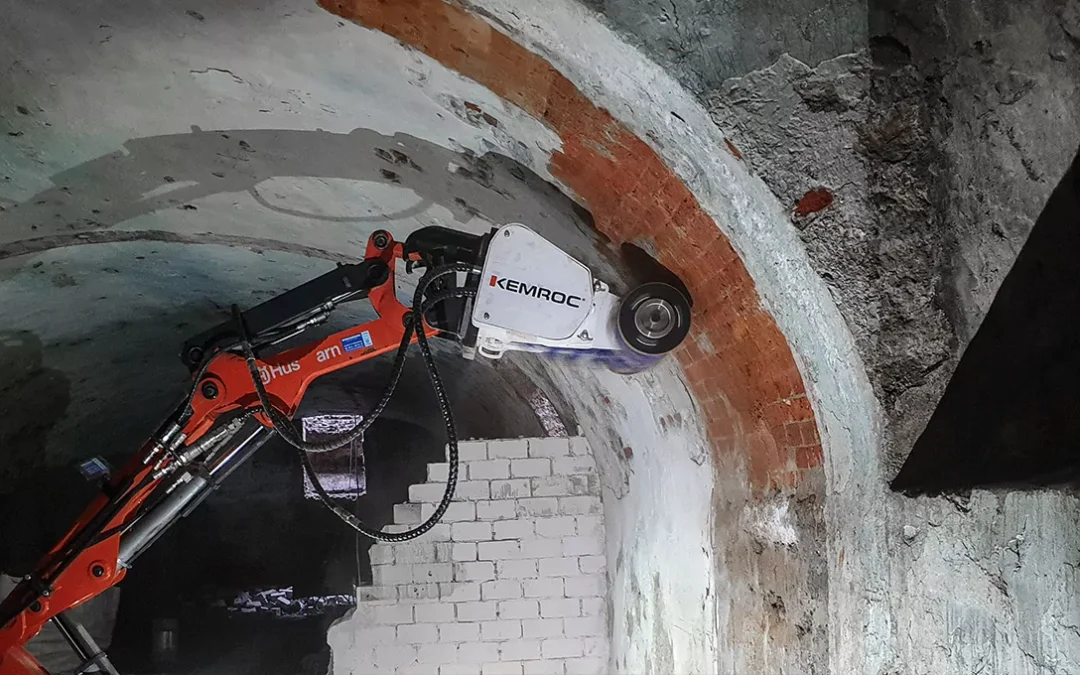
Only after the equipment was back on reliable ground could we refocus on the actual purpose of the trip. A KEMROC cutter cannot demonstrate precision trenching, controlled trench width, or fine-grained reusable output in gypsum rock unless it is properly mounted and positioned on site. Episode 2 shows that in remote mining operations, recovery and logistics are part of the process long before the first pass through rock.