
Utility trenching in rock used to mean one thing: headaches. Slow progress, excessive spoil, and unpredictable results that blow budgets and schedules. But there’s a revolution happening on job sites across the country, and it’s changing everything about how we install utilities in rocky terrain.
The Old Way vs. The New Way
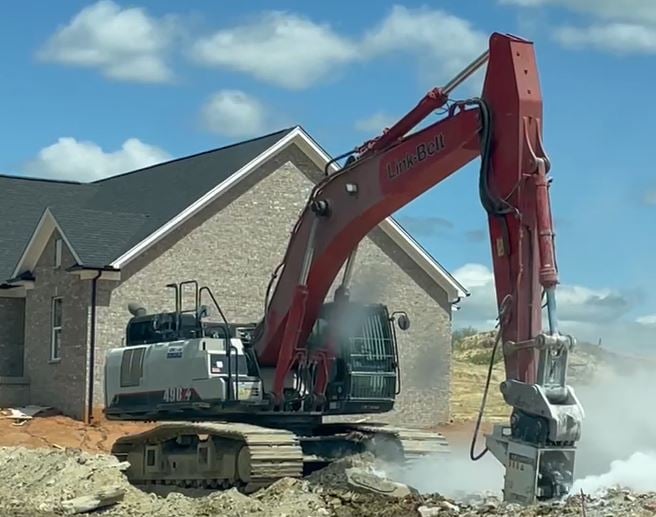
For decades, contractors had limited options when faced with rock during utility installations. You either brought in the hammers for a slow, jarring operation or called in the blasting crew with all their permits, safety zones, and unpredictability.
Both approaches meant wide trenches, tons of unusable spoil, and project timelines that stretched like a foreman’s patience on a Monday morning.
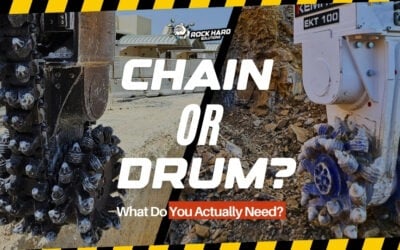
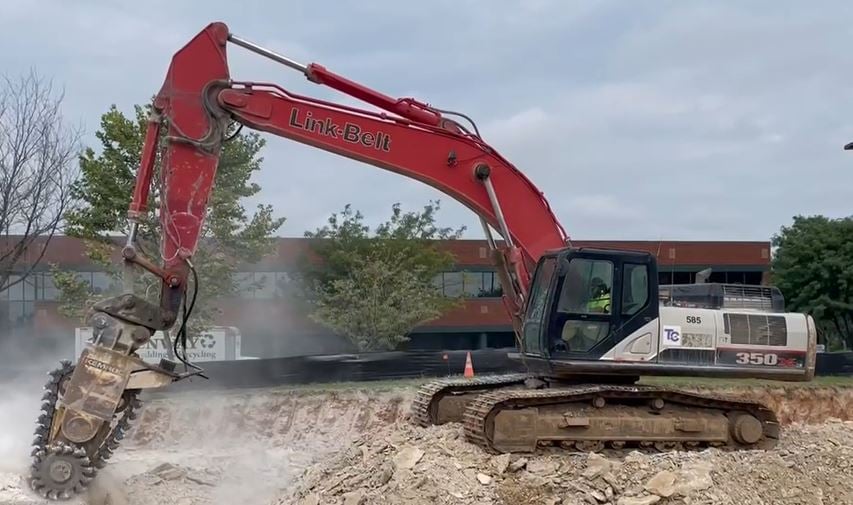
Enter the chain cutter—specifically, KEMROC’s patented EK series. These game-changing attachments are rewriting the rules of utility trenching in rock, delivering precision, efficiency, and cost savings that traditional methods can’t touch.
What Makes Chain Cutters Different?
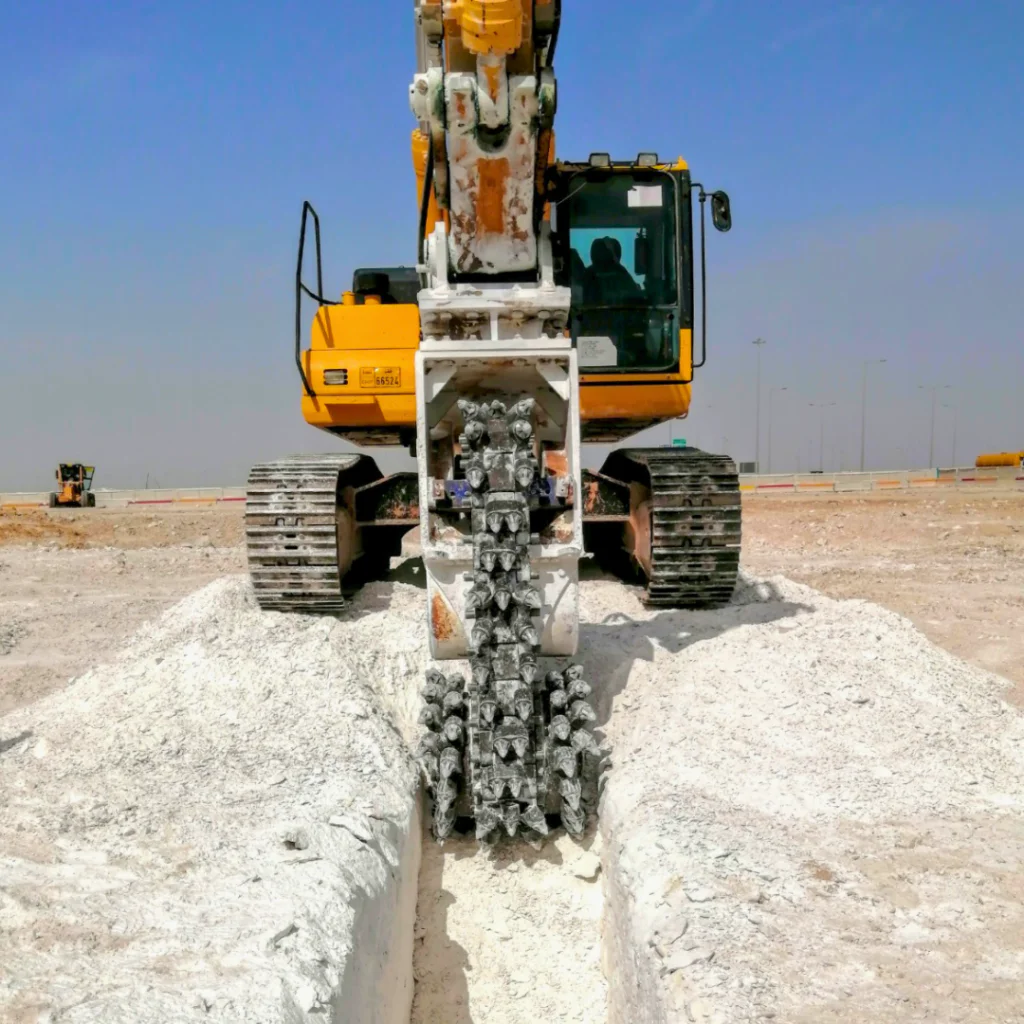
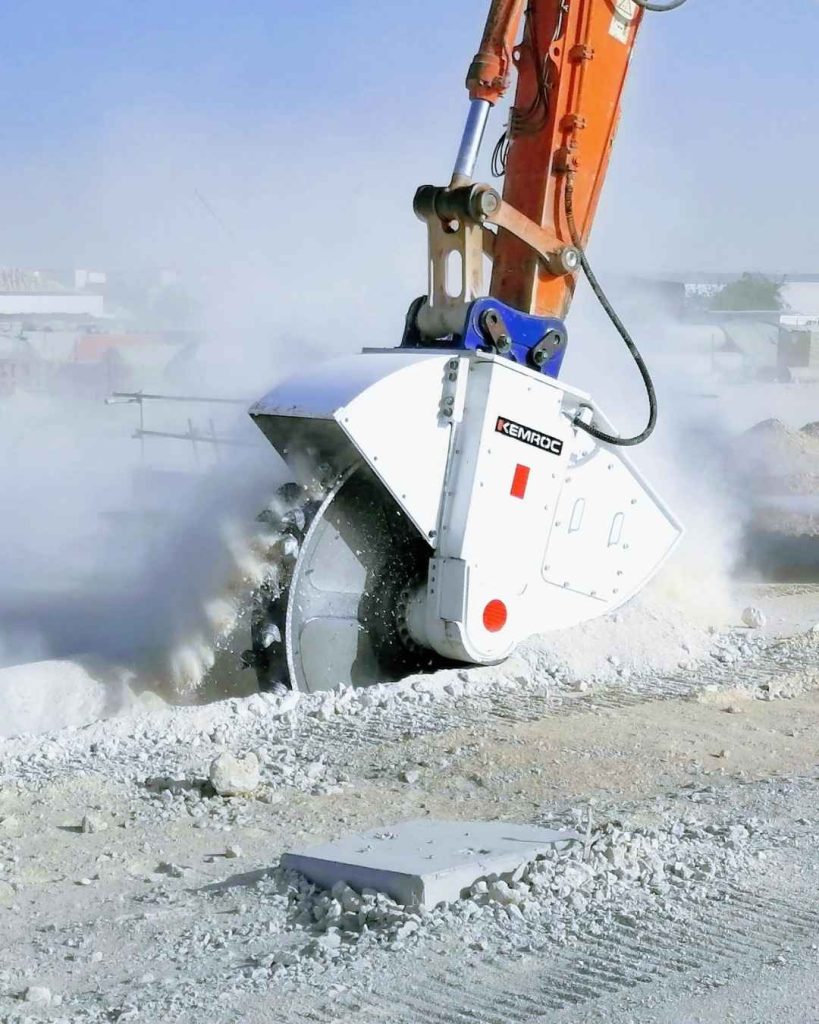
KEMROC’s EK chain cutters feature a unique design that sets them apart from conventional rock removal methods. The secret is in the patented central cutting chain positioned between two cutter drums.
This innovative configuration allows for:
- Narrower trenches – as slim as 16 inches (390 mm), with depths reaching up to 30 feet (10 meters)
- Bucket-like operation that eliminates swing motion and reduces wear on your excavator
- Fine-grained output material that’s perfect for immediate reuse as backfill
- Energy efficiency that reduces consumption by up to 40% compared to conventional drum cutters
- Underwater capability without modifications for those wet utility projects
The precision of these chain cutters transforms how contractors approach utility trenching projects. By creating the narrowest possible trench for the application, you immediately reduce the volume of material removed, amount of backfill required, surface area needing restoration, and overall project duration.
The Numbers Don’t Lie: Production Rate Boosts
When it comes to trenching in rock, production rates tell the real story. And the numbers for chain cutters are impressive.
Richard Kidd, a superintendent who’s seen the difference firsthand, puts it bluntly: “We had one of the smaller chain cutters on a previous project, the first one we tried, and our production went from 20-30 feet to 80-100 in a day. The production has tripled versus a hammer.”
That’s not an isolated case. Contractors across different regions and rock types report similar productivity gains:
- 3x faster trenching compared to hydraulic hammers
- 40% less energy consumption than conventional drum cutters
- Production rates of 4 cubic yards per hour in medium-hard limestone
Narrower Trenches, Bigger Savings
One of the most significant advantages of chain cutters is their ability to create precisely sized trenches—no wider than absolutely necessary for the utility being installed.
Traditional methods often create trenches that are 30-50% wider than needed, which means:
- More rock to remove
- More material to haul away
- More backfill to purchase and bring in
- More surface restoration costs
With KEMROC chain cutters, contractors are seeing immediate financial benefits. Will Hurst, a company owner who made the switch, reports: “KEMROC attachments have performed exceptionally well for us, allowing us to save approximately $100,000 on this project.”
The math is simple: narrower trenches equal less waste and lower costs.
Reusable Spoil: The Hidden Game-Changer
Perhaps the most underrated advantage of chain cutters is the quality of the material they produce. Unlike the large, jagged chunks created by hammers or blasting, chain cutters generate fine-grained output that’s ideal for immediate reuse.
“The product that comes out of the ditch, we can reuse it back in. I don’t have to buy rock,” explains Will Hurst, highlighting a benefit that dramatically impacts project economics.
Isiah Newman, another business owner, echoes this sentiment: “We saved thousands of dollars. Not only were we able to backfill with the same material, but we also don’t have to haul in any gravel or anything. So we saved a lot of money on this project.”
When you eliminate the need to:
- Haul away excavated material
- Purchase engineered backfill
- Transport that backfill to the site
…the savings compound quickly, especially on larger projects.
Precision That Protects Existing Infrastructure
Utility contractors face a growing challenge: installing new lines in areas already crowded with existing infrastructure. In these scenarios, precision isn’t just about efficiency—it’s about avoiding costly damages.
Ahmed Kamal, a Transport & Maintenance Manager with over a decade of KEMROC experience, notes: “KEMROC attachments are about 3x more productive than jackhammers. With KEMROC, I can detect utilities while working without the disruptions caused by jackhammers.”
The controlled cutting action of chain cutters allows operators to work with surgical precision around existing utilities, reducing the risk of accidental strikes and service interruptions.
Streamlined Operations: Doing More With Less
Traditional rock trenching often requires multiple pieces of equipment and several operators. The inefficiency adds up in equipment costs, labor, and coordination complexity.
Rick Hughes, an experienced operator, explains the difference: “If I was running a hammer, I would have to have a track operator, a truck, and hammer the rock out. Of course, by doing so, that makes your pit a lot wider for the trench. By running a KEMROC trencher, I’m able to do that by myself without any other equipment.”
He adds: “You are eliminating a truck, track hoe, 2 operators outside of the trencher. Productivity-wise I’m getting right at 4 cubic yards an hour, which is pretty good.”
This operational streamlining translates to:
- Reduced equipment costs
- Lower labor requirements
- Simplified logistics
- Faster project completion
Case Study: Pipeline Installation Speed
The impact of chain cutters on project timelines can be dramatic, especially for utility contractors working under tight deadlines.
Nabeel Al-Qarbi, an Equipment & Maintenance Manager, shares a compelling comparison: “I’m working right now on a zone. If I’m using the jackhammer, it will take me 2 months. I have 2 Chain Cutters dedicated to a zone; KEMROC attachments can get the job done in 2 weeks.”
That’s an 87% reduction in project duration—turning a 60-day project into an 8-day job.
Ben Coffman, a business owner, describes how chain cutters improved his pipeline installation workflow: “With KEMROC, the operators were able to excavate in 31 m increments, enabling pipe layers to immediately follow behind and lay the pipeline efficiently.”
This continuous operation model, where excavation and installation happen in close sequence, dramatically reduces overall project timelines.
Beyond Speed: Safety and Environmental Benefits
The advantages of chain cutters extend beyond productivity and cost savings. Safety improvements and environmental benefits are increasingly important to contractors and project owners alike.
Mike Wallingford, a Safety Director, highlights the safety angle: “The KEMROC attachment here allows a nice smooth transition, keeping away from all of those fractures, which puts all of our company’s workers in a much safer environment.”
The reduced vibration and controlled cutting action minimize the risk of rock fractures that could compromise worker safety or damage nearby structures.
On the environmental front, chain cutters offer several benefits:
- Lower noise levels compared to hammers
- Minimal ground vibration
- Less fuel consumption due to higher efficiency
- Reduced truck traffic for material removal and delivery
Bryan Cavan, a company owner, notes: “KEMROC attachments not only expedited our project over conventional methods but also operate much quieter than a hoe ram, which makes the neighbors satisfied.”
In noise-sensitive areas or projects with strict environmental requirements, these benefits can be the difference between moving forward and facing delays or restrictions.
The Right Tool for the Job: KEMROC Options
KEMROC offers several chain cutter models to match different excavator sizes and project requirements:
- EK Series: Dedicated chain cutters with models ranging from the compact EK 20 for 2-4 ton excavators to the powerful EK 220 for 50-75 ton machines
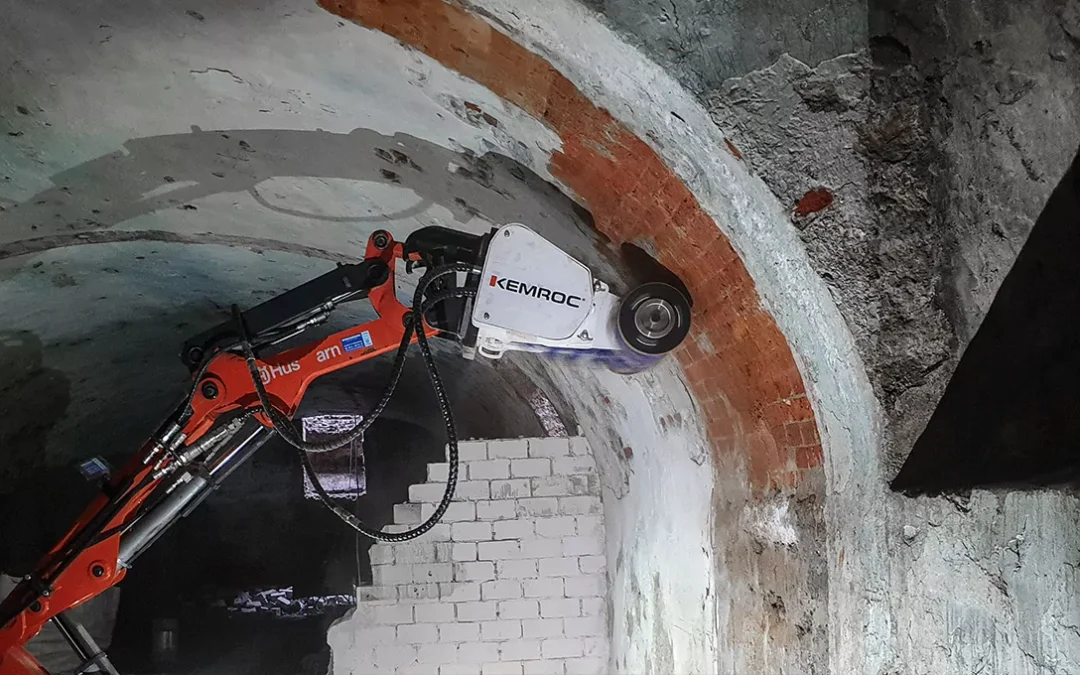
- EKT Series: Convertible attachments that can function as either drum cutters or chain cutters, offering versatility for contractors who face varying project requirements
For utility trenching specifically, popular models include:
- EK 100: Compatible with 18-25 ton excavators, creating trenches 24 to 29 inches wide
- EKT 110: A convertible option for 18-25 ton excavators, offering both chain cutting and drum cutting capabilities
Making the Switch: What Contractors Need to Know
If you’re considering making the switch to chain cutters for your utility trenching projects, here’s what experienced contractors recommend:
- Match the attachment to your excavator: KEMROC offers models for machines from 2 to 120 tons
- Consider your typical trench specifications: Width and depth requirements will guide your model selection
- Factor in rock hardness: While all KEMROC attachments handle soft to medium rock, specialized models are available for material up to 140 MPa
- Calculate the full project economics: Include savings from reduced spoil handling, backfill costs, and faster completion times
- Talk to contractors who’ve made the switch: Their real-world experience can provide valuable insights
The support ecosystem matters too. Richard Kidd emphasizes: “The support from KEMROC, the cutters, and CMC is excellent. Anytime I call one of the members at CMC, they immediately answer the phone, and they’re on top of it. Never left me hanging.”
The Bottom Line: Revolution, Not Evolution
What’s happening with chain cutters in utility trenching isn’t just an incremental improvement—it’s a fundamental shift in how these projects are approached and executed.
The combination of narrower trenches, reusable spoil, higher production rates, and operational streamlining is transforming project economics and timelines. Contractors who’ve made the switch aren’t going back.
As Ahmed Kamal, who manages a fleet of 15 KEMROC attachments, puts it: “We have been using KEMROC attachments for almost 12 years now. Their productivity and quality are 3 times better than the jackhammer, and they work perfectly underwater.”
For utility contractors facing rock on their next project, the question isn’t whether you can afford to try chain cutters—it’s whether you can afford not to.
Ready to revolutionize your utility trenching operations? Give us a call. We’ll help you find the right KEMROC attachment for your toughest rock challenges.
Sources:
1.KEMROC Product Knowledge Base, Rock Hard Solutions, 2025
2.”Customer Testimonials,” KEMROC, 2025, https://www.kemroc.com/en/customer-testimonials/
3.”EK Chain Cutters for Excavators,” KEMROC, 2025, https://www.kemroc.com/en/products/ek-chain-cutters/
4.”KEMROC Chain Trenchers: Trenching Solutions for Excavators,” KEMROC, 2025, https://www.kemroc.com/en/products/ktr-chain-trenchers/
5.”Save Big with KEMROC Attachments: A Testimonial from the Field,” KEMROC, January 9, 2025, https://www.kemroc.com/en/save-big-with-kemroc-attachments-a-testimonial-from-the-field/