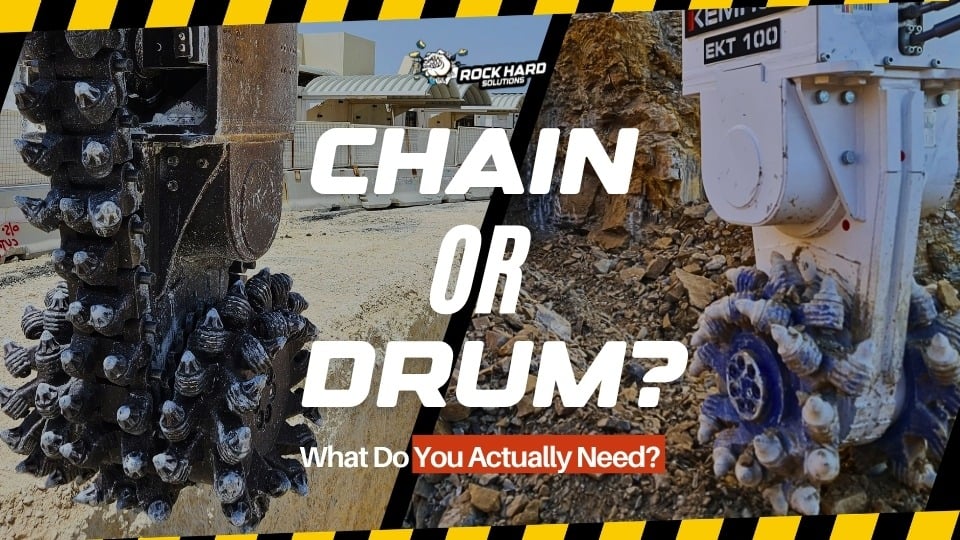
If you are working in rock…
…and you are trying to decide between a chain cutter and a drum cutter, picking the wrong one can cost you a lot of time and a lot of money.
That is why this question matters.
Contractors ask it all the time. Should I be using a chain cutter or a drum cutter?
The answer is simple, but it is not one-size-fits-all.
It depends on the job.
That is what the chain cutter vs drum cutter decision comes down to. They are both rock cutting tools, but they are built for two very different kinds of work. Pick the right one and the job moves. Pick the wrong one and you can spend all day fighting the machine.
Why the Chain Cutter vs Drum Cutter Decision Matters
A lot of contractors first see these machines and assume they do basically the same thing.
They do not.
Both cut rock, but they are meant to solve different problems in the field. That is why the chain cutter vs drum cutter decision is not about which one is better overall. It is about which one fits the work in front of you.
That choice affects production, trench width, material handling, and total job cost.
So before you pick an attachment, you need to know what kind of job you are actually asking it to do.
What Changed for Us
I am not just looking at this as someone selling attachments.
My family owns T&C Contracting, and for years we did what most contractors do when we hit rock. We ran hydraulic breakers.
Over time, the same problems kept showing up. Repair costs, slow production, and too much time spent fighting rock the hard way.
Then we started working with cutters.
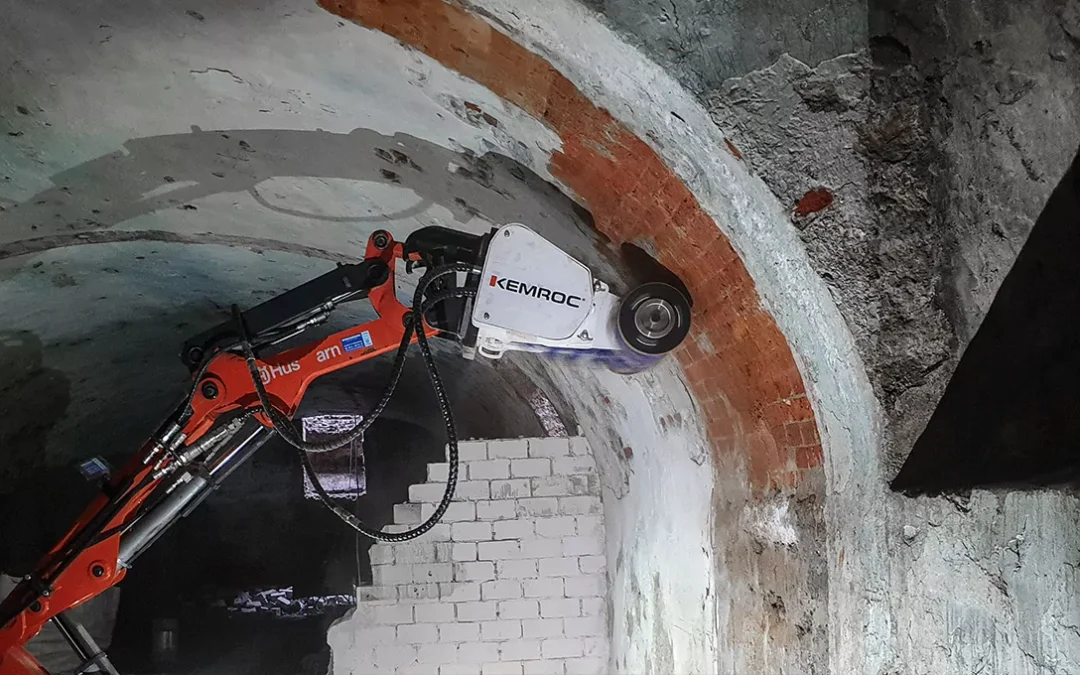
Once we saw what they could do on the right jobs, it changed the way we handled rock excavation. Today we have replaced our breakers with a fleet of KEMROC cutters for our day-to-day work.
That is what led me to become a dealer and help more contractors here in the U.S. get their hands on the right tool for the job.
Drum Cutters Are Built for Volume
If the job is moving a lot of rock in an open area, start by looking at a drum cutter.
That is what it is built for.
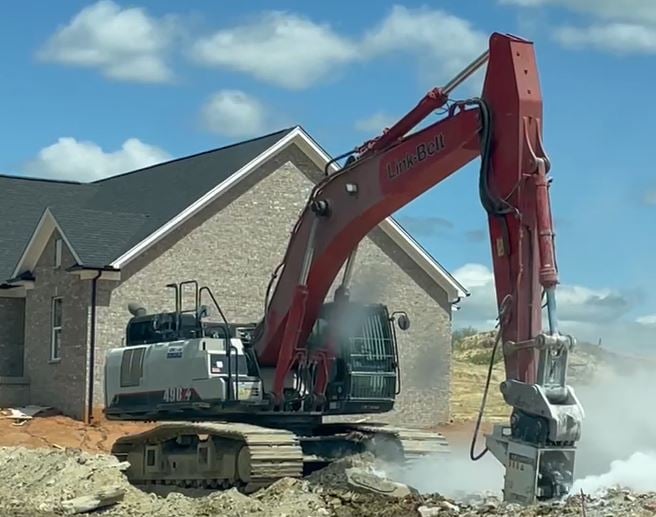
A drum cutter is your tool for mass rock removal. It grinds through rock continuously and keeps material moving when cut width is not the main concern.
That makes it a strong fit for foundations, road construction, large excavation zones, and other open-area applications where the goal is production.
This is where the drum cutter earns its keep. When you need volume, it is the workhorse.
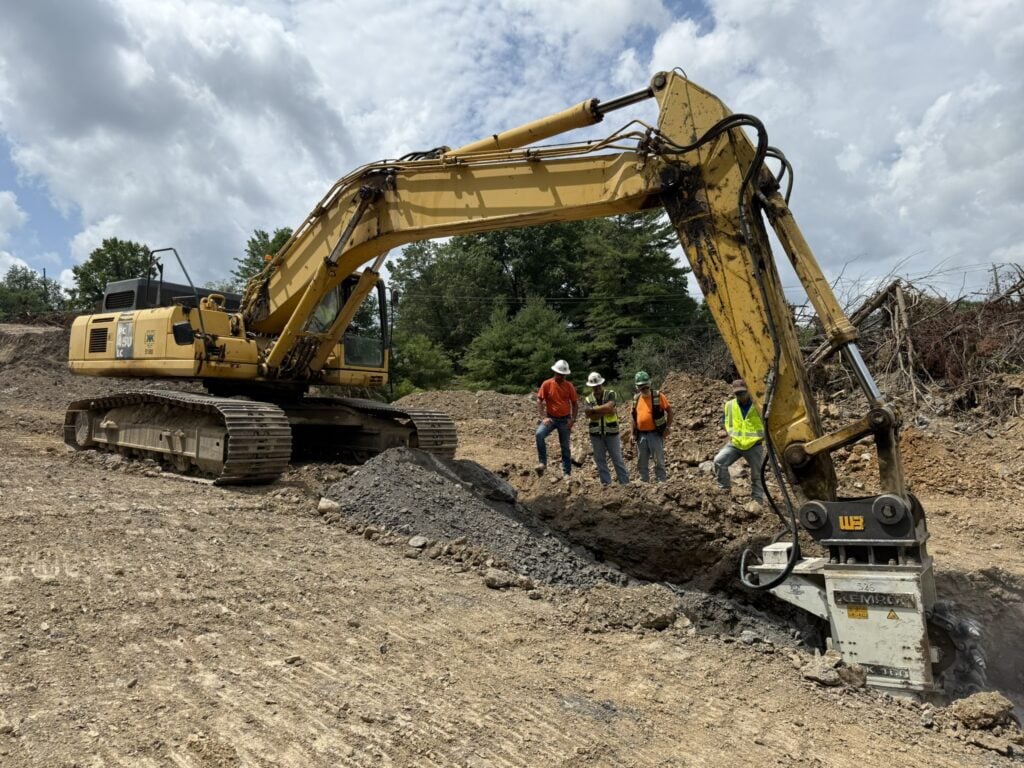
We saw that on the Bourbon Distillery project. On that job, we removed more than 60,000 cubic yards of rock using drum cutters. The attachment let us process the rock efficiently and keep production moving.
If the job is about moving a lot of material, this is usually where you want to be.
Chain Cutters Are Built for Precision
Now look at the other side of the chain cutter vs drum cutter decision.
A chain cutter is built for precision.
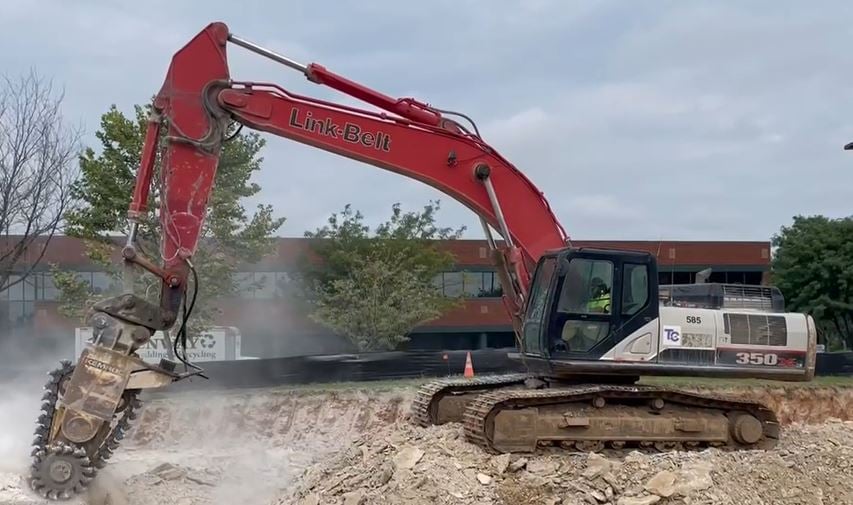
The chain running down the center of the attachment allows it to cut extremely narrow trenches with clean, vertical sides. That is a major advantage on work where trench width matters.
Utilities. Pipeline. Narrow foundation footings.
That is chain cutter work.
With a drum cutter, you may remove more material than you really need. With a chain cutter, you cut the trench width the job actually calls for.
That means less over-excavation, less material to haul away, and less concrete or backfill going back into the trench.
On the right jobs, that difference saves real money.
The Wrong Choice Creates More Work
This is where the chain cutter vs drum cutter comparison really starts to matter.
If you use a drum cutter on a job that really calls for a narrow trench, you can end up taking out too much material and creating extra work for yourself on the back end.
If you use a chain cutter on a job that really calls for open-area production, you may be using the wrong tool for the amount of material you need to move.
That is how contractors lose time.
Not because the machine does not work, but because it is being asked to do the wrong kind of job.
The right tool makes the work easier. The wrong tool makes the day longer.
A Simple Way to Think About It
If you want the quick version of the chain cutter vs drum cutter decision, here it is.
Drum cutters are built for volume.
Chain cutters are built for precision.
That is the simplest way to think about it.
Both solve rock excavation problems. They just solve different ones. Once contractors understand that, the decision usually gets a whole lot easier.
Why Seeing It on Your Own Job Matters
A lot of contractors understand the difference once they hear it explained.
But the best way to really know what fits your work is to run it on your own jobsite.
That is why we offer a try-before-you-buy option.
We will bring the attachment to your site, help install it on your excavator, and show your operator how to run it the right way.
Run it on your job for a month. Once contractors see what it can do under their own conditions, most of them decide they want to keep it.
And if it is not the right fit, no problem. We will take it back and get it into the hands of the next contractor who is ready to put it to work.
Final Thoughts on Chain Cutter vs Drum Cutter
If you are trying to sort out the chain cutter vs drum cutter question, do not start with the attachment. Start with the job.
If the work is open-area rock removal and production matters most, a drum cutter is usually the better choice.
If the work is narrow trenching where cut width, cleaner sides, and less over-excavation matter most, a chain cutter is usually the better fit.
That is the difference.
At Rock Hard Solutions, we work with contractors every day to help them match the tool to the job instead of guessing and paying for it later. If you want to talk through your next project and see which cutter makes the most sense, reach out and let’s talk.